A worker crossing a roof to a unit, eyes on the task, puts a boot on what reads as solid roofing. The plastic dome is weatherproofing. It was never built to take a body, and years of sun make it brittle. Falls through skylights are one of the most consistent ways people die on roofs, because the hazard is invisible right up until it gives. The fix is quiet and permanent: a screen over the opening that stops the fall and still lets the light through, and never touches the skylight itself.
Most roof hazards fall under the general four-foot rule. Skylights get their own callout: 29 CFR 1910.28(b)(3) requires that a skylight in a walking-working surface be guarded by a screen, a cover rated to hold the load, or a guardrail. The reason it's named separately is the failure mode. A skylight doesn't look like an edge or a hole, so a worker steps where they'd never step near a parapet, and the dome that looks like a floor isn't one. It's the window, not a barrier.
So the question an inspector is really asking is simple: if someone put their weight on that skylight, what stops them? A dome is not an answer. A rated screen, a rated cover, or a rail around it is. We'll tell you which of the three fits your roof, and we won't screen a skylight nobody could reach to make a quote look bigger.
Screen each one, or fence the cluster. The layout of the skylights and the foot traffic decides which is simpler.
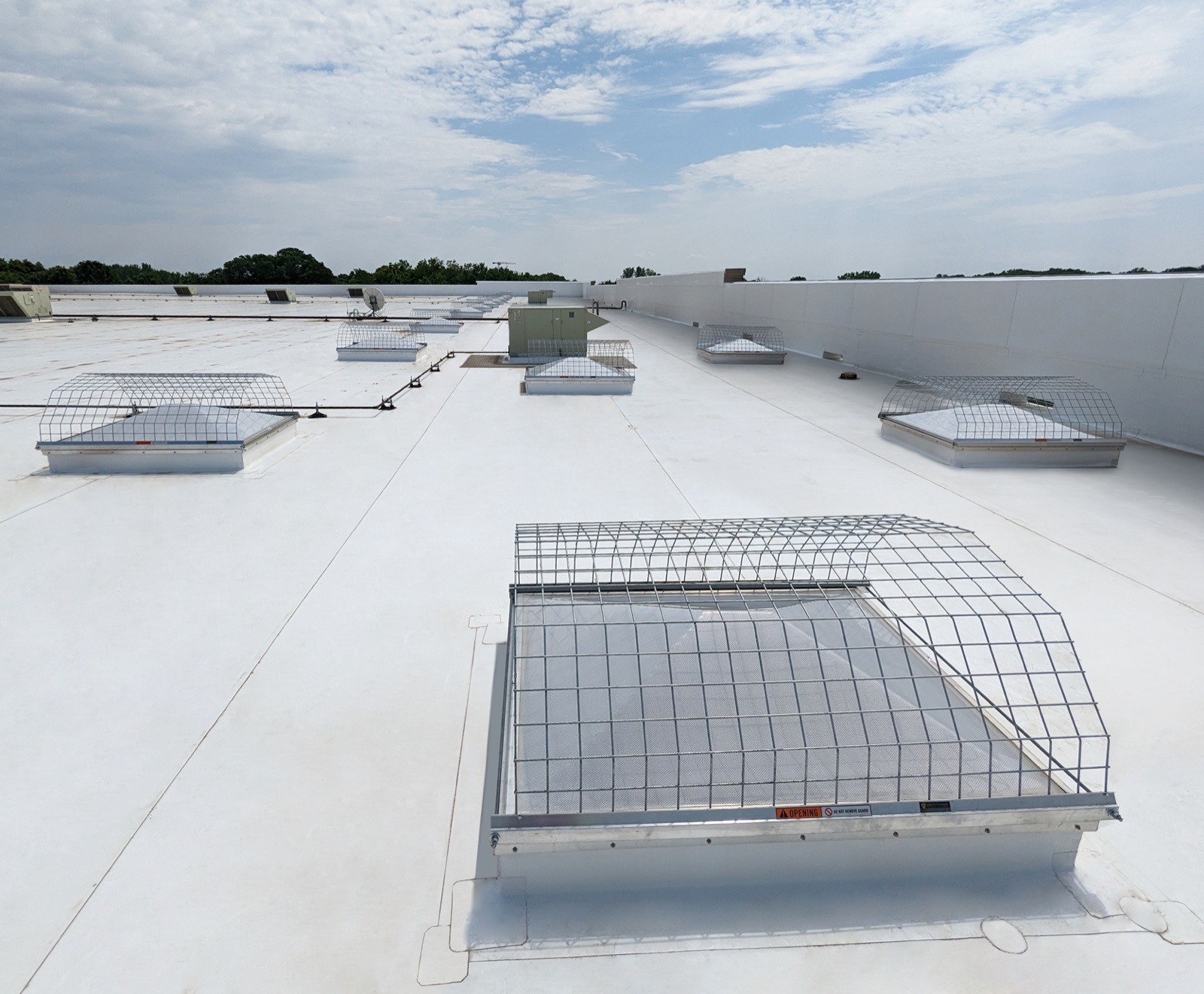
A load-bearing mesh screen or cage that sits over the curb and takes a body's weight while passing daylight. Non-penetrating, no holes through the roof, no touching the skylight. The everyday answer for a single skylight or a scattered few.
Where skylights bunch together and people walk among them, a run of non-penetrating guardrail fencing the whole group can be cleaner than screening each one. Same no-drill base.
Skylights rarely travel alone. There's usually a hatch and an edge in the same walk. One visit catches the hatch, the skylights, and the edge off one read.
To replace the skylights. The protection goes over them, the light stays, the roof stays sealed. To screen a skylight in a corner no one can reach and no path leads to. We guard the ones that are actually in play and tell you which ones aren't.
Yes. A plastic dome is weatherproofing, not a fall-protection surface. It isn't rated to hold a person, and aged domes get brittle in UV. Falls through skylights are a recurring fatality because the dome looks solid until someone's weight is on it. OSHA addresses skylights under 1910.28(b)(3): a skylight in a walking surface must be protected by a screen, a rated cover, or a guardrail.
Under 1910.28(b)(3), a skylight in or near a walking surface must be guarded against the fall-through. By a screen or cage strong enough to take a person's weight, by a cover meeting the same load criteria, or by a guardrail around it. The dome itself counts toward none of those; it's the window, not a load-rated barrier.
For a single skylight or a scattered few, a non-penetrating screen over each curb is usually cleanest. It removes the fall-through right at the opening and still passes light. For a tight cluster people walk among, a run of guardrail fencing the whole group can be simpler. The layout decides; we read it on the walk.
No. An open-mesh screen passes daylight while stopping a body, and non-penetrating mounts mean no holes through the membrane and no roofer. We don't touch or replace the skylight. The protection goes over it, so the light stays and the roof stays sealed.
Skylights hide in plain sight. Nobody clocks them as holes until you map the route a worker actually walks to the rooftop unit and see which ones sit in the line. We walk that path, flag every skylight in play, and pair it with the hatch and edge that come with it. Then we put in writing the part nobody else does: the skylights out of reach that don't need a thing.
Three ways in: the free Site Visit (one roof, read and quoted) · the Operational Assessment (every skylight and opening across the operation, logged against the standard) · the Fast-Lane RFQ (know the count and sizes? send it, get it quoted).
We come walk the path your crew actually takes. Flag every skylight in the line, read it against the standard, and hand you the screen list with the drawing. Free, every time.
Book the visit →Skylight count, curb sizes, where they sit relative to foot traffic, or a few photos. Send it and we'll turn the screen quote fast, drawing and code references attached.
Start an RFQ →