Watch the moment: a worker pushes the hatch open, climbs the last rung, and steps onto the roof with both hands occupied and a three-foot-square hole right behind their heels. The cover did its job when it was shut. It does nothing for the person at the open hatch, and that handoff between the ladder and the roof is where people go down it. The fix is small, cheap, and one of the first things an inspector checks: a rail around the opening with a gate that closes itself.
Strip away the height and a roof hatch is a hole in a walking-working surface, and that's how the standard treats it: a fall hazard addressed under 1910.28 and the guardrail criteria of 1910.29. The cover satisfies the requirement only while it's closed, and it's never closed at the moment that matters, when a person is half on the ladder and half on the roof. The protection the standard is reaching for is a barrier that's present during the transition: a rail around the opening and a self-closing gate where the worker comes through.
The chain people hang across the ladder side instead? It sags, it gets left unhooked, and it's the first thing an inspector reaches out and tests. A self-closing gate takes the decision away from the worker. It closes whether they remember to or not. That's the difference between a fix that holds on the walkthrough and one that doesn't.
A hatch fix is small and standard. The only real choices are how it mounts and whether the openings around it deserve the same look.
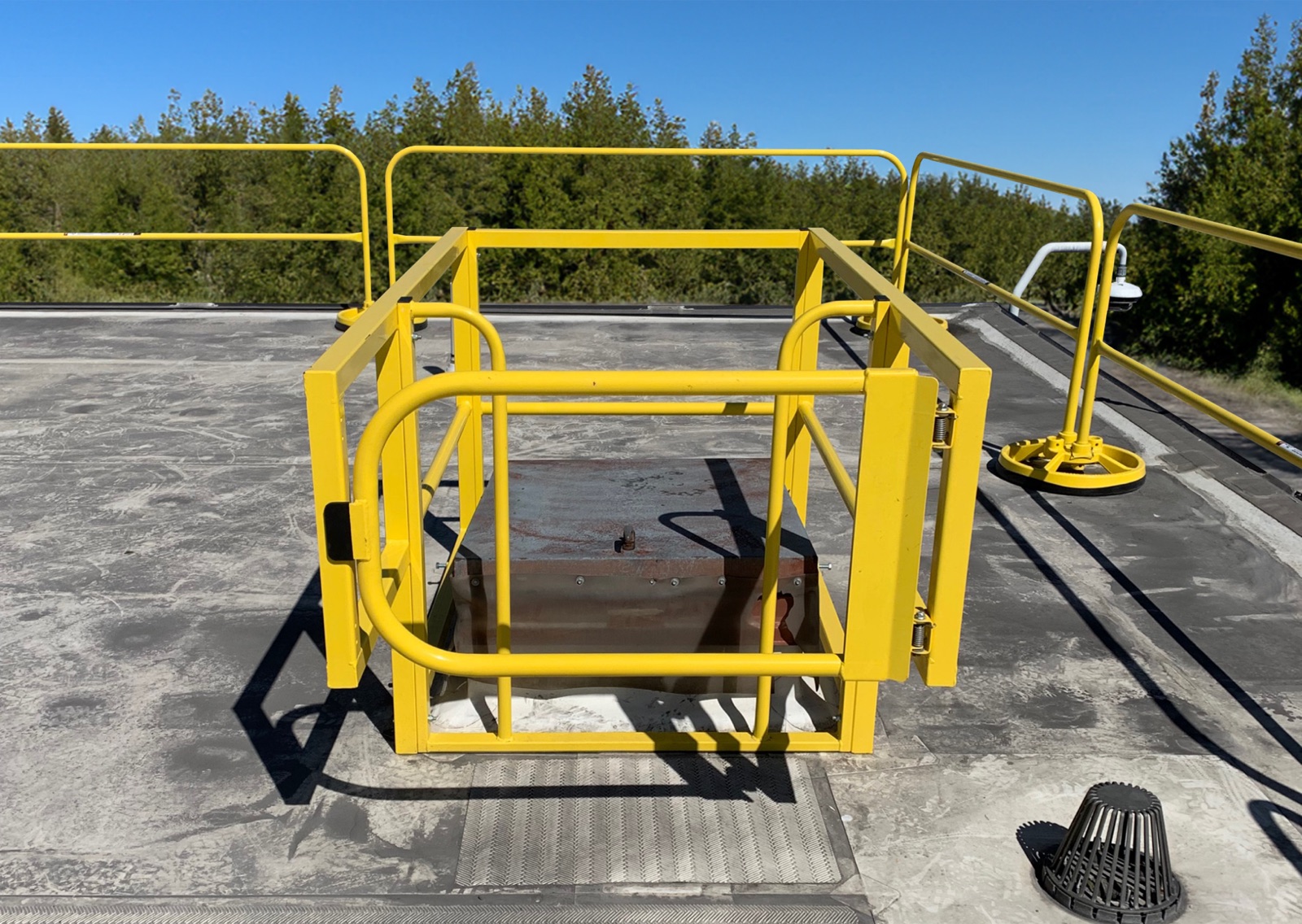
A fixed rail around three sides of the opening with a spring gate at the ladder side. The worker is enclosed climbing through and the gate shuts behind them. The everyday answer, full size range.
Where you don't want new roof penetrations, a guard that clamps to the hatch curb or sits on the deck, no-tool options, up the same day, no holes through the membrane.
The hatch is rarely the only exposure up there. If the roof edge or a cluster of skylights is in the same walk, a run of non-penetrating guardrail closes it all off the same visit.
A custom-fabricated assembly, a roofer, or any roof work. A standard hatch rail with a self-closing gate covers it. We won't upsell the opening into a project. It's a small part that closes a real exposure, and that's all it needs to be.
The cover protects the hole when it's closed; it does nothing for the worker standing at the open hole with both hands on the ladder. An open hatch is a hole in a walking surface, addressed under 1910.28 and 1910.29. A hatch rail rings the opening and adds a self-closing gate at the ladder side, so the person climbing through is never exposed to the open edge. Most hatches need both.
An open hatch is treated as a floor hole and a fall hazard above four feet, so protection follows guardrail criteria under 1910.29. A rail roughly 42 inches high around the opening. With a self-closing gate rather than a removable chain at the access side, so a worker transitioning between ladder and roof always has a barrier between them and the opening.
Often yes. Many hatch guards mount to the hatch curb itself or to the roof deck with non-penetrating and no-tool options, so they go up the same day without new roof penetrations. The right mount depends on the curb and the deck. A quick read on a walk.
No. It's one of the least expensive fixes on the whole roof, which is why it's frustrating when it gets cited. A standard hatch rail with a self-closing gate is a small, off-the-shelf part, usually the easiest line on a quote to approve, and it retires an exposure inspectors look for early.
An open hatch on a walk almost always travels with company: a skylight near the path, an edge nobody guarded, a ladderway with a chain. They're all small, all citable, and they all close off one short visit's worth of standard parts. We list every one, read it against the standard, and put in writing the part nobody else does. The openings that are already fine and don't need a dime.
Three ways in: the free Site Visit (one roof, read and quoted) · the Operational Assessment (every opening across the operation, logged against the standard) · the Fast-Lane RFQ (know the hatch size? send it, get it quoted).
We come stand at the hatch. Catch every opening on the roof, read them against the standard, and hand you the fix list with the drawing. Free, every time.
Book the visit →Hatch dimensions, the curb type, ladder side, or a couple of photos. Send it and we'll turn the guard quote fast, drawing and code references attached.
Start an RFQ →