A freestanding, counterweighted guardrail that stands on the roof instead of through it. No drilling, no membrane penetration, no leak path to argue about with your roofer, and no harness, anchor, or rescue plan for the crew, because a guardrail protects everyone on the roof, all the time. Reconfigurable when the rooftop changes, galvanized or safety-yellow, and referenced to OSHA 29 CFR 1910.29. The same line protects parapets, leading edges, mezzanine edges, and work centers around the plant.
OSHA reads fall protection as a hierarchy, in this order: a guardrail that removes the hazard for everyone, then travel restraint that keeps you from the edge, then personal fall arrest that catches you after you've fallen, then a warning line that just tells you the edge is near. Passive beats active for a reason. A guardrail needs no harness, no anchor inspection, no trained user, and no rescue plan, so it protects the contractor and the new hire exactly as well as your safety lead.
Where this matters to your budget: we regularly see a roof edge quoted as an engineered rigid-rail anchor system. The most expensive tier. When a freestanding guardrail and a self-closing gate would have covered it passively for a fraction. The honest read works the other way too: when the work happens on top of a truck or railcar, or moves along the hazard where you can't guard the edge, rigid-rail arrest is the right call and we'll say so. The walk decides. The hierarchy is how we keep the answer right-sized inside the code.
Every configuration below stands on the roof without penetrating it, ships in standard lengths from 2 to 10 feet (or custom), and reconfigures when your rooftop layout changes, which is why the quotes come fast and the parts don't go to scrap when the units move. Arrived from a specific problem? Start at crews near an unprotected roof edge.
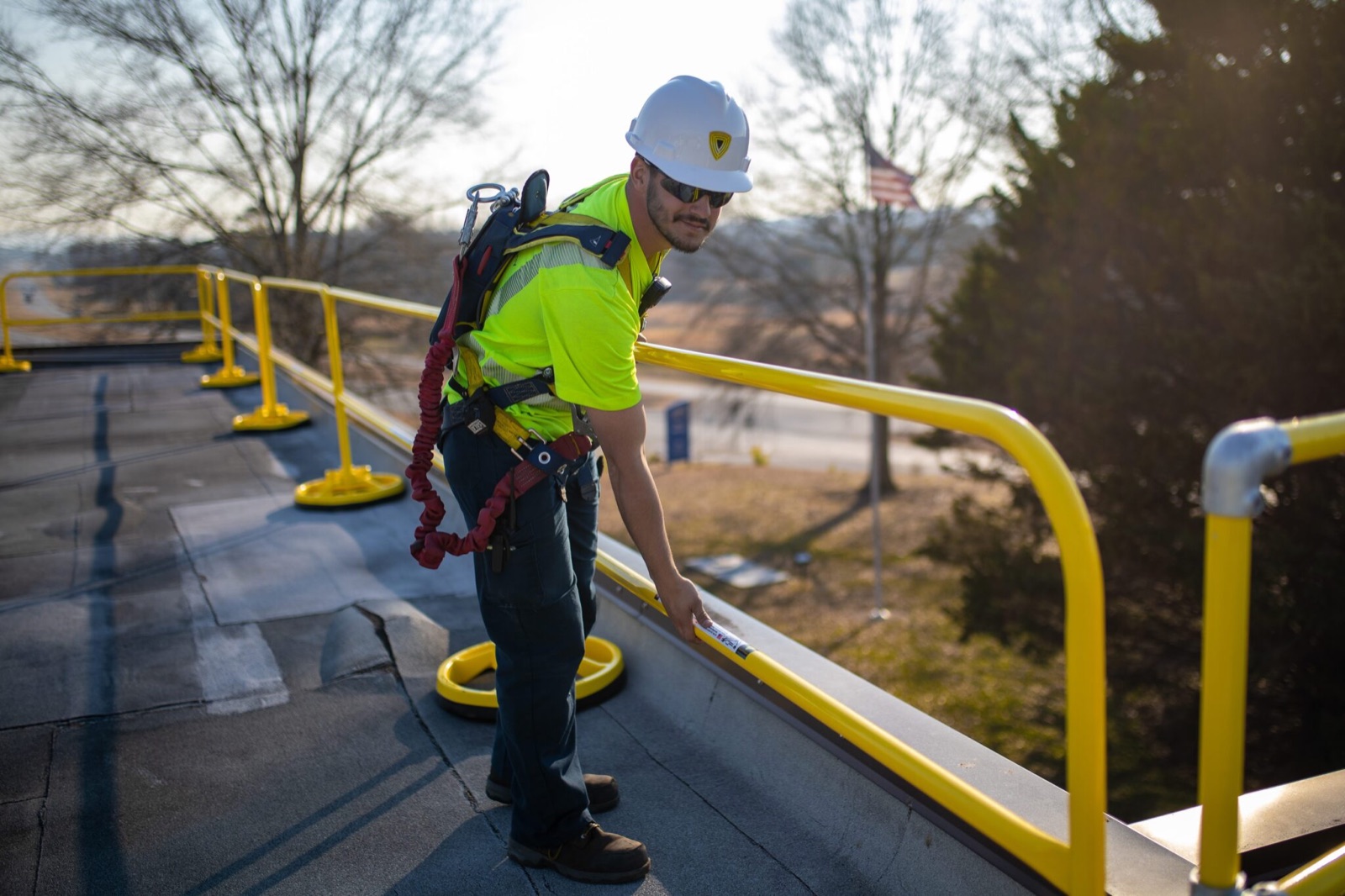
The flagship: a counterweighted base that lets a single run pivot a full 360° around rooftop units, curbs, and pipe without field welding. The everyday answer for an unprotected roof edge or leading edge.
Straight and curved stanchion profiles for rooflines where appearance carries. Same non-penetrating base, a cleaner silhouette where the public or the tenant can see it.
For roofs that already have a low parapet, a base engineered to that condition. Low-profile, no intermediate counterweights stacked across your walking path to trip on.
Railing that drops out of the sight line without tearing the system down. For parapets, view corridors, and rooftops where a permanent vertical rail isn't wanted full-time.
Prefabricated bolt-up sections for a fixed work center, walkway, or restricted-access zone. Removable for access when you need it, engineered and referenced like the rest.
Passive perimeter for poured and precast concrete edges. 10/8/5-ft sections with integrated toeboard, referenced to OSHA, Cal-OSHA, and the IBC. The temporary-edge job, done passively.
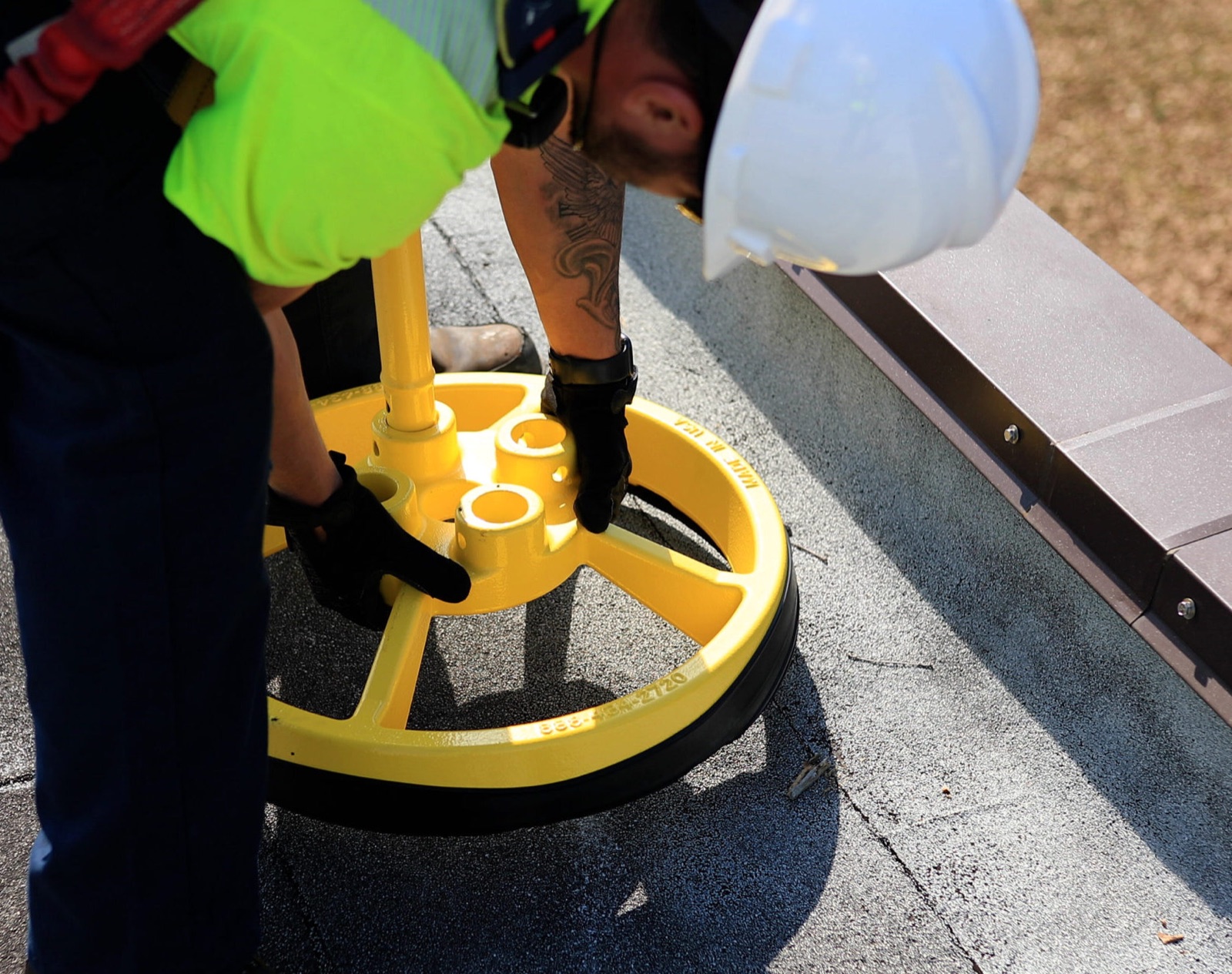
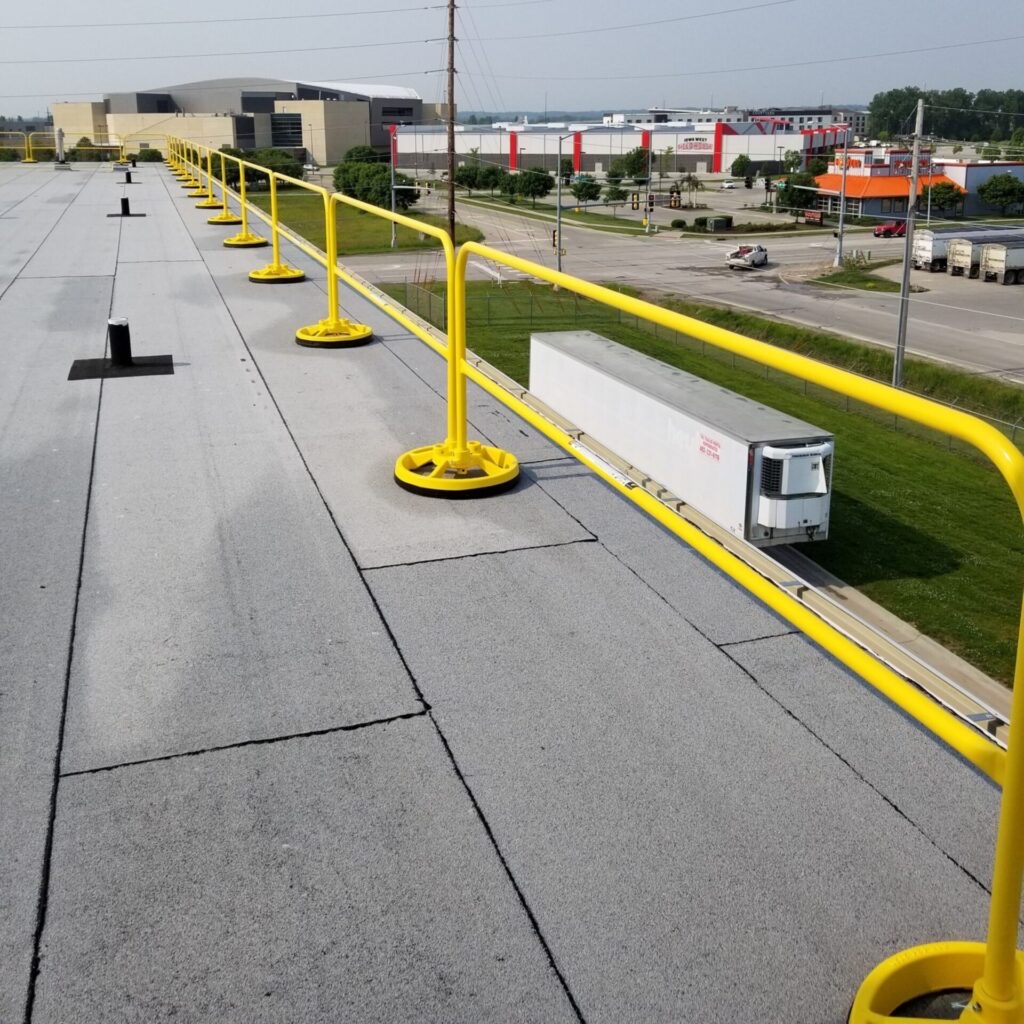
Material: hot-dip galvanized standard; powder-coat safety yellow or custom color available. Need corrosion-grade rail for washdown or coastal/chemical service? We hold the aluminum option through HEMCO. See the Apollo aluminum series.
Some work can't be guarded. The crew is on top of the truck, the railcar, or the tote, or the job travels a bay where a guard rail would be in the way. That's the case OSHA's hierarchy steps down to personal fall arrest, and an engineered overhead rigid rail keeps a worker tied off the whole task. It's the honest exception to "guardrail first", never the default. See overhead rigid-rail & portable fall arrest →
Often the rail and a gangway get specified together. The gangway carries the worker out, the rail keeps them tied off. Same exposures as railcar and tanker top access.
We'll be straight about both. Anchored rail and stanchions drilled into the roof mean penetrations through the membrane, a roofer back to flash every one, a warranty conversation, and a leak path that's yours forever. A non-penetrating guardrail skips all of it: it stands on the membrane, distributes its load, and lifts off clean when the roof gets recoated. And where a competitor reaches for the engineered fall-arrest tier on a roof you could simply guard, the hierarchy is the tell. Passive first, and the passive answer is usually the cheaper one.
Where penetration or arrest is genuinely the right answer, no roof to stand a base on, or work you truly can't rail off. We'll tell you that too, and engineer it properly. Pretending otherwise is how trust dies.
Describe the edge in plain words and give us the run length (or photos and a satellite view. We'll take it from there), and the preliminary layout and line-item quote come back fast. Engineered drawings follow with the order.
| System | Non-penetrating freestanding guardrail. Counterweighted base, no drilling, welding, or roof penetration |
|---|---|
| OSHA reference | Tested & independently certified in accordance with 29 CFR 1910.29 (general industry) / 1926.502 (construction); fall protection generally triggered at 4 ft per 1910.28(b) |
| Rail geometry | Top rail 42″ ±3″, 200 lb load (no deflection below 39″); midrail 150 lb; toeboard where falling objects are a hazard |
| Section lengths | 2 to 10 ft standard, or custom; 360° rotation around rooftop obstructions |
| Finish | Hot-dip galvanized standard · powder-coat safety yellow · custom color · aluminum via HEMCO for corrosive/washdown service |
| Reconfiguration | Installs and moves without tools; fold-down (Hide-A-Rail) option preserves sight lines; lifts off clean for roof recoat |
| When it's not the answer | Work on top of trucks/railcars or along a hazard you can't guard → engineered rigid-rail fall arrest; openings & hatches → hatch, skylight & gate protection |
Yes. The base is counterweighted, so the guardrail stands on the roof rather than through it, no drilling, no membrane penetration, no leak path to argue about with your roofer. The system we supply is tested and independently certified in accordance with OSHA 29 CFR 1910.29, installs without tools or welding, and reconfigures when the rooftop layout changes.
Most of the time, a guardrail, and that usually costs less. OSHA's hierarchy prefers passive guardrail over personal fall arrest, because a guardrail protects everyone on the roof without a harness, an anchor, a rescue plan, or training. We regularly see a roof edge quoted as an engineered rigid-rail anchor system when a freestanding guardrail and a self-closing gate would have handled it passively. Rigid-rail arrest is the right answer when you genuinely can't guard the edge. Over a truck or railcar, or where the work moves along the hazard. The walk decides which, and we'll tell you when it's the cheaper one.
Under 29 CFR 1910.29, the top rail sits 42″ ±3″ above the surface and must withstand 200 lb without deflecting below 39″; the midrail resists 150 lb; a toeboard is added where objects can fall on people below. Fall protection is generally triggered at four feet in general industry under 1910.28(b). Every system we quote is built to those criteria and ships with the drawing and the code reference, but the ruling on your specific roof comes from a walk, not a website.
Yes. A fold-down (Hide-A-Rail) configuration drops the railing out of sight lines without dismantling the system, for parapets and rooflines where appearance matters. The architectural line adds curved and straight stanchion profiles for the same reason.
Plain words and a rough run length are enough. The preliminary layout and quote come back fast, drawings with the order.
Describe the edge →We'll walk the roof, run it against OSHA's hierarchy, and right-size the system, including when the passive, cheaper tier is the answer.
Book the visit →