The HVAC tech changing a belt. The contractor on the condensers. The maintenance guy clearing a roof drain after a storm. Every one of them works a stride or two from a thirty-foot drop, on a roof nobody guarded because "they're careful up there." It's the exposure that looks fine until the day it isn't, and the fix doesn't touch your roof. A guardrail that stands on the membrane, not through it, takes the edge out of the equation for everyone who ever goes up.
In general industry, 29 CFR 1910.28(b) generally calls for fall protection from four feet, and 1910.29 sets what a guardrail has to be. A top rail at 42 inches give or take three, able to take 200 pounds without folding. The part that decides the citation isn't the height; it's the routine. A roof people service on a schedule, near an edge nobody guarded, reads as a known, repeated exposure. The kind enforced hardest because it was foreseeable.
And here's the lever on your budget: OSHA's hierarchy prefers a passive guardrail over a harness-and-anchor system, because the guardrail protects everyone without depending on a worker clipping in correctly every time. So when a roof edge gets quoted as an engineered rigid-rail anchor system, that's usually two tiers higher than the code asks for. We read your edge against the hierarchy and tell you the passive answer where it fits, which is most of the time.
One run of guardrail rarely fits every roof the same way. The right answer is the configuration that takes the edge out of play where the work actually happens.
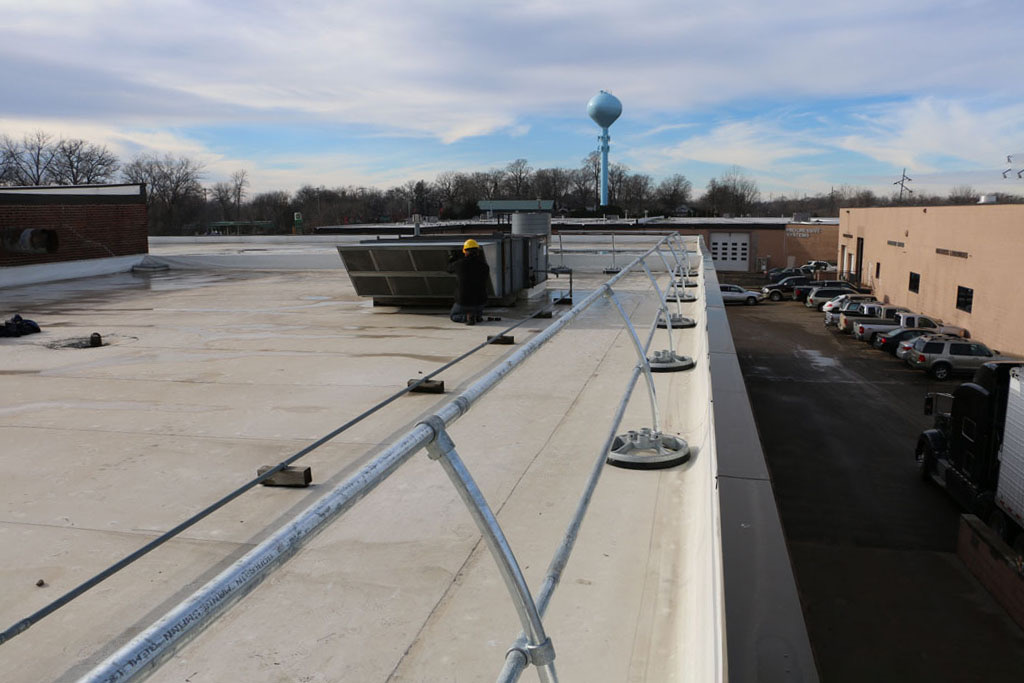
The everyday answer: a counterweighted base that stands on the membrane and pivots around units and curbs without drilling. Up fast, lifts off clean for a recoat. Leads on cost and on OSHA's hierarchy.
Where a building owner doesn't want a permanent vertical rail in the sight line, a fold-down or curved-profile run guards the edge during work and drops out of view after. Same non-penetrating base.
If there's genuinely no edge to guard. Work that travels a parapet-less roofline you can't rail. An engineered overhead rail is the honest step down the hierarchy. The exception, not the default.
A drilled-and-flashed stanchion system on a roof a freestanding base sits on fine. A rigid-rail anchor system, harnesses to inspect, and a rescue plan on an edge you can simply guard. We size the protection to the edge and the work, and we'll tell you where the cheaper, passive answer is the right one.
In general industry, 1910.28(b) generally triggers fall protection at four feet, and a roof edge clears that many times over. Where work happens within about 15 feet of the edge, a guardrail is the passive answer OSHA's hierarchy prefers; the moment routine work brings a person near the edge, a guardrail removes the question.
No. A non-penetrating guardrail stands on the roof on a counterweighted base, no holes through the membrane, no re-flashing, no leak path your roofer warranties. It lifts off clean when the roof is recoated. Drilled stanchions are a real option only where there's a structural reason a freestanding base won't sit.
Usually a guardrail, and it usually costs less. OSHA's hierarchy prefers passive guardrail over personal fall arrest because a guardrail protects everyone on the roof with no harness, no rated anchor, no rescue plan, and no training to keep current. We regularly see a guardable edge quoted as a rigid-rail anchor system. The walk is where we right-size it back down.
A warning line is the bottom of OSHA's hierarchy. It tells a worker the edge is near but doesn't stop a fall, and it only applies in limited situations with a trained, monitored crew. For an edge people work near on a schedule, it's rarely the honest answer. We'll say plainly when a warning line fits and when it's just the cheap-looking option that won't hold up.
When we walk a roof for the edge, we catch what comes with it. The hatch with a cover but no rail, the skylights near the service path, the ladder with a chain instead of a gate. None of it is expensive, all of it is citable, and it closes off one short list. The part nobody else puts in writing comes too: which stretches of edge don't need rail at all because nobody works near them.
Three ways in: the free Site Visit (one roof, read and quoted) · the Operational Assessment (every rooftop exposure across the operation, logged against the standard) · the Fast-Lane RFQ (know the run? send it, get it quoted).
We come stand on the roof. Find every spot work happens near the edge, read it against the standard, and hand you the guardrail that takes it out of play, with the drawing. Free, every time.
Book the visit →Edge length, roof type, where the work happens, or a few photos and a satellite view. Send it and we'll turn the guardrail quote fast, drawing and code references attached.
Start an RFQ →