Cracking a hatch. Gauging the level. Pulling a sample. Venting the top. Every one of those puts a person fifteen feet up on a curved steel surface, often for two minutes, often without anything between them and the ballast. It's the task that never made the SOP and the one an inspector heads straight for. The fix isn't a louder safety talk. It's engineered access that takes the climb away entirely.
The walking surfaces and platforms around the spot answer to 29 CFR 1910.28(b) from four feet, and the ladders to 1910.23. But the top of the car itself? There's no single tidy line of code. It's governed by interpretation letters and the General Duty Clause, 5(a)(1), which is precisely why it gets enforced by judgment, case by case. Inspectors know the routine, unprotected climb is where plants are most exposed, so it's where they look.
Harness-and-tie-off can play a role, but it leans on a certified anchor at the right height, a rescue plan, and perfect use every single load, and busy racks are where "every single load" quietly fails. Engineered access flips the logic: put a guarded, level surface over the car and there's nothing to fall from. We'll tell you what we'd flag at your spot, and which combination of deck, gangway, and cage actually removes it.
One product doesn't fit every car. The right answer is the combination that puts a guarded, level surface exactly where the work happens.
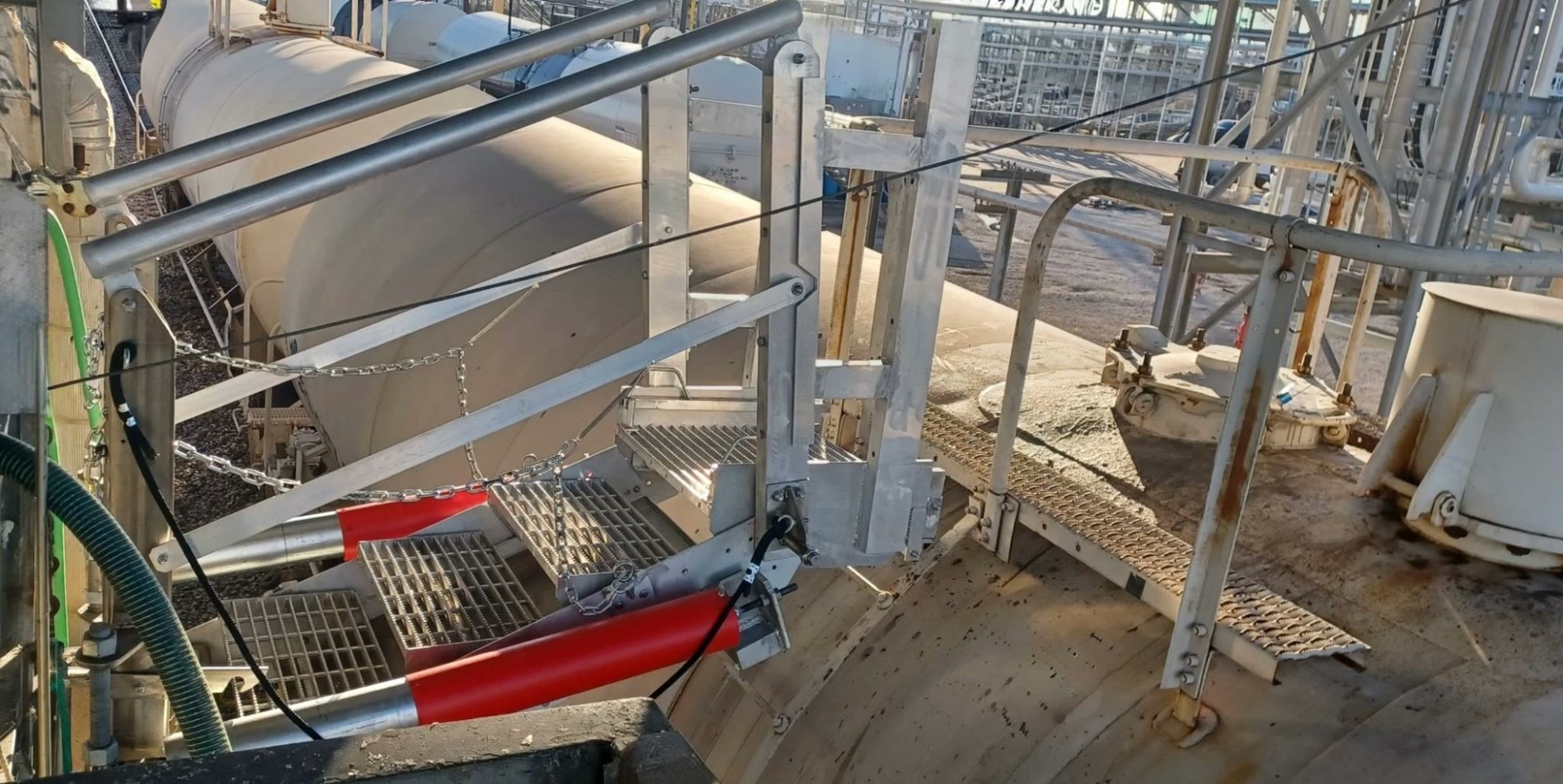
A full, level deck over the whole top with all-around fall protection. For multi-hatch work where crews gauge, sample, and connect across the car. The most complete answer for the spot that runs every shift.
A self-leveling gangway with a cage that drops around the hatch. The worker is enclosed while they work the lid. Leading with Apollo, the engineered line. The everyday answer for single-hatch loading.
For the car that gets spotted twice a month, a mobile gangway rolls in, sets up in minutes, and gives the same caged, level access, no fixed install for a spot that doesn't earn one.
A full wide-access deck on a spot that loads one hatch twice a month. A gangway and a cage cover it. A fixed install on a car you barely run. A mobile unit does. We size the access to the work, and we'll tell you where less is the right answer.
Above four feet, 1910.28(b) requires fall protection on the walking-working surface, and 1910.23 governs the ladders and stairs that reach it. Car tops themselves are governed more by interpretation letters and the General Duty Clause than any single standard. In practice the accepted answer is engineered access. A gangway and guarded surface that removes the climb and the exposure.
A gangway bridges from a fixed platform to the car and levels to it; a hatch cage drops around the hatch so the worker is enclosed; a wide-access gangway gives a full deck across the whole top for multi-hatch work. Most spots use a gangway plus a cage; high-throughput multi-hatch spots use the full deck.
It can be part of the answer, but it depends on a certified anchor at the right height, a rescue plan, and consistent use every load, which is where it tends to break down on a busy rack. Engineered access removes the exposure instead of managing it. Most plants land on engineered access as primary, with tie-off as backup where it fits.
Yes. The standard is about the exposure, not the duration. Two minutes on top of a car to crack a hatch or pull a sample is still a fall hazard above four feet, and it's usually the task that never made the written SOP, which is exactly the kind of routine, unprotected climb inspectors flag.
Car-top work hides in the gaps of the SOP. The vent on the older car, the sample QA pulls, the gauge check the driver does. We walk your spots and name every one of them, then hand you the right-sized access that takes the climb away. Including the part nobody else puts in writing: which spots don't need a fixed install at all.
Three ways in: the free Site Visit (one spot, solved and quoted) · the Operational Assessment (every car-top task across the operation, logged against the standard) · the Fast-Lane RFQ (know the spot? send it, get it quoted).
We come stand at the spot. Name every car-top task, read it against the standard, and hand you the access that removes the climb, with the drawing. Free, every time.
Book the visit →Car type, hatch positions, spot dimensions, or a few photos. Send it and we'll turn the access quote fast, engineered drawing and code references attached.
Start an RFQ →