"We bottom-load, so we're covered" is the most common, and most cited. Assumption at the rack. But the connection moving to the bottom doesn't keep crews off the top. They're up there to vent the older trailers, pull the sample, gauge the level, wash it out. Two minutes on a wet, curved, fifteen-foot surface counts the same as an hour. The fix is taking the climb away, sized to the trailers you actually load.
The loading diagram says bottom-load, so the rack gets built and the access never gets budgeted. But the inspector doesn't read the diagram. They watch the crew. And the crew still goes up: to crack the hatch and vent vapor on older trailers, to pull the retain sample, to check the gauge, to wash out between products. Every one of those is elevated work above four feet under 29 CFR 1910.28(b), with the access stairs under 1910.23.
That gap. Between "how we load" and "what the crew actually does up top". Is the single most common citation at a bottom-load rack, because nobody counted the two-minute climbs. The honest move is to name them and remove them: a self-leveling gangway and cage, or a platform, that gives a guarded surface for the up-top work that bottom-loading was never going to eliminate.
The trailers vary in height and the tasks vary by product. The access has to level to both, and not cost more than the spot is worth.
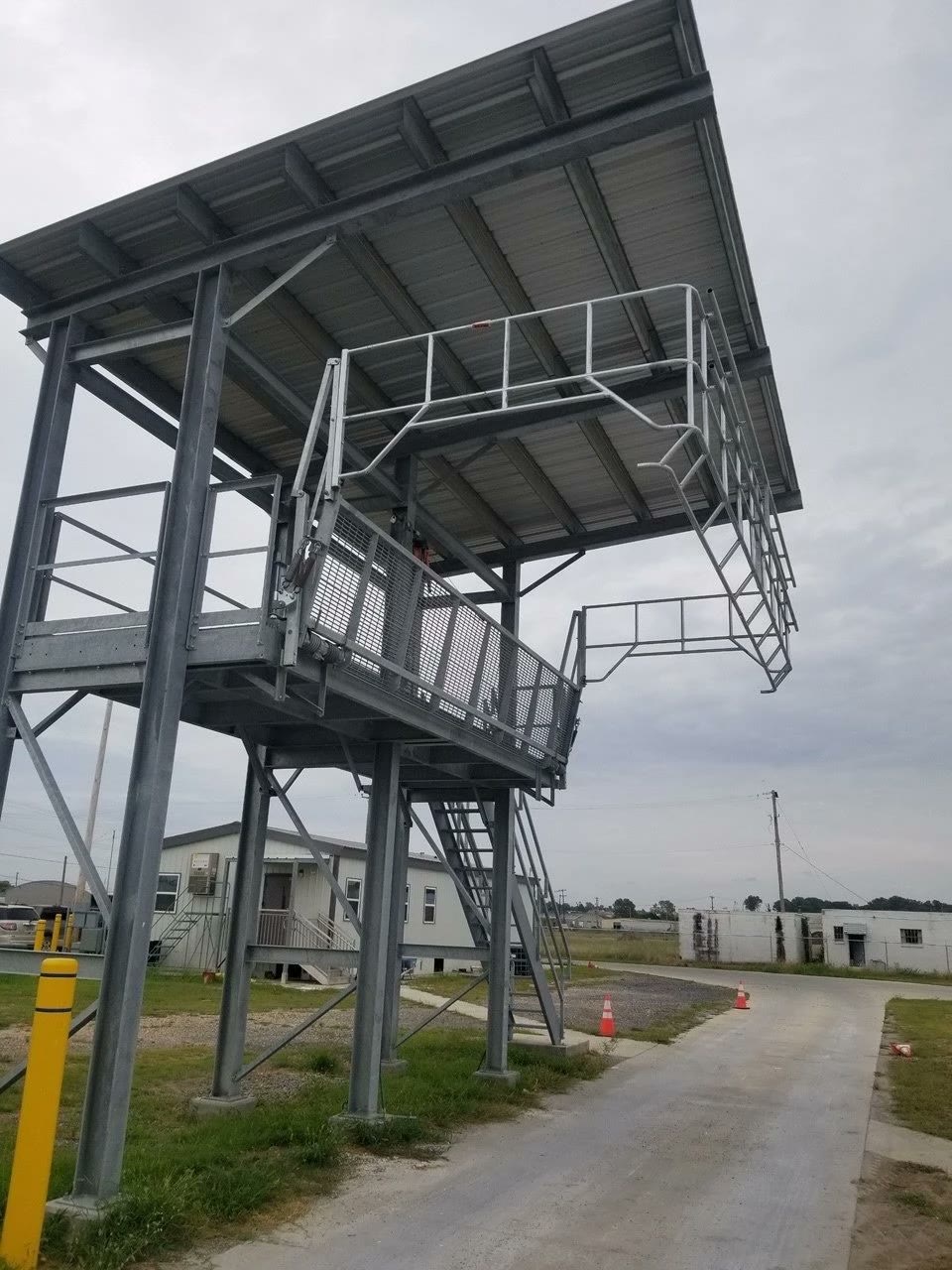
The everyday answer: a gangway that levels to each trailer height with a cage around the hatch, so venting and sampling happen enclosed. Leading with Apollo, the engineered line, in the metal your product calls for.
When crews move across the whole top. Full washdown between products, multi-hatch work. A full level deck with all-around protection. The complete answer for the high-throughput spot.
For the spot that loads a few times a week, a mobile gangway rolls in and gives the same caged, level access, no civil work, no fixed install for a bay that doesn't run hard.
A full wide-access deck on a spot where the only up-top task is a quick vent. A gangway and cage cover it. A fixed install on a bay that loads twice a week. A mobile unit does. We size the access to the up-top work that's actually there, not to the rack you imagine.
Usually yes. Bottom-loading moves the product connection to the bottom, but crews still go up top to vent older trailers, sample, gauge, and wash out. Every one elevated work above four feet under 1910.28(b). Bottom-loading reduces how often the climb happens; it rarely eliminates it. The cited task is almost always the up-top one nobody counted.
Above four feet on the trailer, 1910.28(b) requires fall protection on the walking-working surface, and 1910.23 covers the access stairs and ladders. The accepted answer for a loading rack is engineered access. A self-leveling gangway and hatch cage, or a platform, that gives a guarded, level surface so the climb is gone.
A self-leveling gangway with a hatch cage handles single-hatch sampling and venting; a wide-access gangway or platform suits full-top washdown where the worker moves across the trailer. The gangway levels to different trailer heights so one spot serves a mixed fleet.
A self-adjusting (self-leveling) gangway, which levels its treads or deck to each trailer through its full range, so a single spot serves tall and short trailers without the operator wrestling it. It's the standard answer for a mixed fleet at one loading position.
"We bottom-load" is where the conversation usually stops, and where the citation usually starts. We walk your rack and name every up-top task that bottom-loading didn't remove: the vent, the sample, the gauge, the washout. Then we hand you the access that takes them off the table. Including the part nobody else puts in writing: the spots where a quick vent doesn't justify a fixed build.
Three ways in: the free Site Visit (one spot, solved and quoted) · the Operational Assessment (every up-top task across the rack, logged against the standard) · the Fast-Lane RFQ (know the spot and the fleet? send it, get it quoted).
We come stand at the rack. Name every up-top task, read it against the standard, and hand you the access that removes the climb, sized to your fleet. Free, every time.
Book the visit →Trailer heights, the up-top tasks, spot dimensions, or a few photos. Send it and we'll turn the access quote fast, engineered drawing and code references attached.
Start an RFQ →