A new spur or loading line for a liquid process means the same thing every time: crews are about to be on top of cars and trucks, opening hatches, gauging, and venting. The cheapest moment in the whole project to get that access right is now, while the civil work is still on paper and the foundations aren't poured. Retrofit it onto a finished loadout and you pay twice. We design it in step with the line.
The day the first car is spotted and a crew climbs to open a hatch, you're under 29 CFR 1910.28(b). Fall protection at four feet, and the access stairs and ladders under 1910.23. On the tops of tank cars, where no single standard maps cleanly, it's the General Duty Clause. None of that waits for the line to be "finished." The exposure starts with the first load.
Which is exactly why designing access into the project. Instead of bolting it on after. Is the whole advantage. Foundations sized for the platform, spot spacing matched to the cars, gangway reach set to the real hatch positions. Do it on paper and it's an engineered detail. Do it after the ribbon-cutting and it's a citation with a clock.
A new line rarely runs at full volume on day one. The access plan should respect that. Covered from the first car, sized to what the line actually becomes.
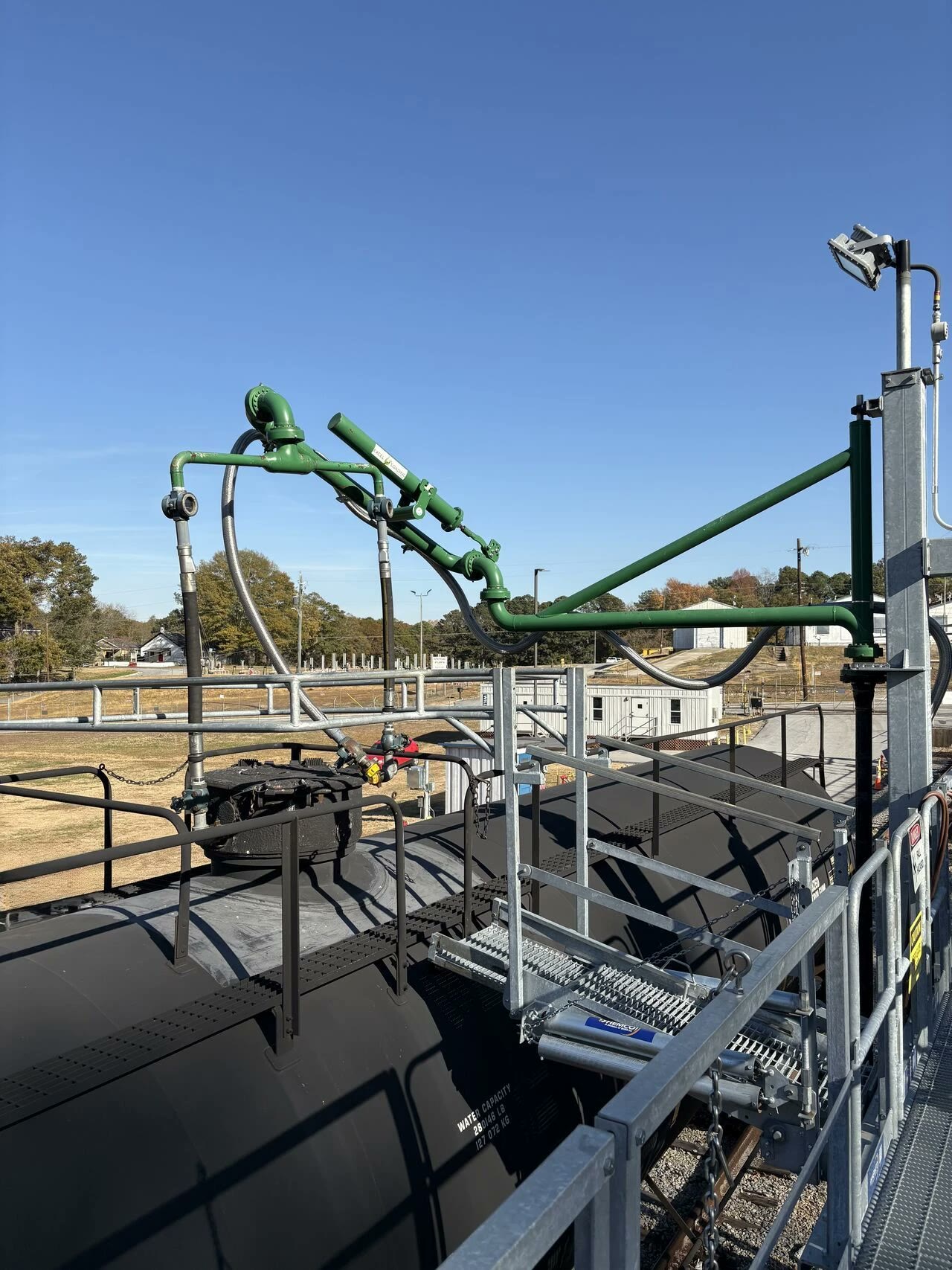
When crews work multiple hatches across the car. Gauging, sampling, hose connections. A full level deck over the top with all-around fall protection. The answer for the spot that runs every shift.
A self-leveling gangway and hatch cage on a fixed platform. Leading with Apollo, the engineered line, in the metal your service calls for. Tracking carriage when one platform covers two spots.
No civil work, on site in weeks. Guarded, engineered access for the spot that's still proving its volume. It captures the real throughput, so the fixed build is pre-scoped the day the line earns it.
A full multi-spot terminal rack for a line running two cars a week. The over-build is easy to sell and slow to install, and it locks in a footprint before you know the line's real shape. We'll size the access to the volume you have and pre-scope the rest for when you get there.
Yes. The moment a crew goes above four feet to open a hatch, gauge, sample, or vent, 1910.28(b) applies, and car and truck tops fall under the General Duty Clause. A new spur is the cheapest possible moment to design that access in. Before the structure is poured and before the first load creates the exposure.
At the same time as the spur and the piping. Designing access alongside the civil work means the foundations, the spot spacing, and the gangway reach all match the cars you'll run, and you skip retrofitting protection onto a finished loadout, which always costs more.
It depends on the car and the work: a wide-access gangway for full-deck multi-hatch work, a single- or double-spot self-leveling gangway with a hatch cage for routine loading, or a mobile unit while the line ramps. We size it to the cars, not to a catalog.
Yes, and it often should. A mobile gangway unit covers a ramping spot in weeks with no civil work, capturing the real throughput, and the fixed spot gets built when the volume earns it. You're covered from the first car without over-building for volume you don't have yet.
A loadout drawing tells us almost everything we need: the cars, the spots, the hatch positions, the ramp profile. We read it against the standard and hand you an access plan that has you covered from the first car and sized to the volume you actually have. Including the part nobody else puts in writing: what you don't need to build yet.
Three ways in: the free Site Visit (walk the plan and the site, get a worked solution) · the Operational Assessment (the whole expansion against every level of compliance, logged) · the Fast-Lane RFQ (send the loadout drawing, get the access quoted).
We come walk the plan and the site. Measure the envelope, match the access to the cars, and hand you a worked solution and a quote. Free, every time. Best done before the foundations are poured.
Book the visit →Send the spur layout or the loadout drawing. We'll turn the access quote fast, engineered drawing and code references attached.
Start an RFQ →