Solvent and coatings blenders. Toll processors. Water-treatment chem. Plants with two, three, six loading spots, where the same crew that runs the line also climbs the tanker to gauge, sample, and vent it. You don't need a sixty-position rack and you shouldn't be priced like you do. We size access to how your plant actually runs, and we'll tell you which spots don't need a fixed install at all.
Mid-market chemical plants run lean. The operator who blends the batch is the one on top of the trailer at 2 PM. Here's where we find the exposure, plant after plant.
QA pulls the retain, the driver checks the level. On top, every load. The most routine task at the rack is usually the least protected.
Older trailers still need the hatch opened to displace vapor, even on bottom-loaded product. Two minutes up top is still a fall exposure. It just never made the SOP. Why "we bottom-load" doesn't cover it →
Growth has a moment: the day drums and totes turn into your first bulk truck, or your first railcar spur. New heights, new hatches, new rules. The time to size access is before the first load, not after the first citation.
Acid wash zones and caustic splash corrode the wrong platform fast. Stainless, galvanized, or aluminum is a judgment call about your chemistry. We make it with you, not for our convenience.
Solvent transfer means bonding, grounding, and the rules of 29 CFR 1910.106 at the rack. The access plan and the static plan have to be designed together.
Spill containment turns into a climbing hazard the day someone has to step over the berm with a sample in hand. No-weld crossover stairs fix it without hot work inside the containment area.
The catwalks, crossovers, and platforms answer to 29 CFR 1910.28(b) from four feet up, and the ladders to 1910.23. Same as any plant. But chemical service stacks the deck: flammable-liquids transfer pulls in 1910.106 (bonding, venting, the rack itself), and whether your inventory sits above or below a PSM threshold changes how OSHA walks in your door entirely.
And the tops of trucks and railcars? Still the grayest territory OSHA enforces. Interpretation letters and the General Duty Clause more than any single line of code. That's where judgment earns its keep: we'll tell you what we'd flag at your rack, what we'd expect to be fine, and which side of the thresholds you're actually on.
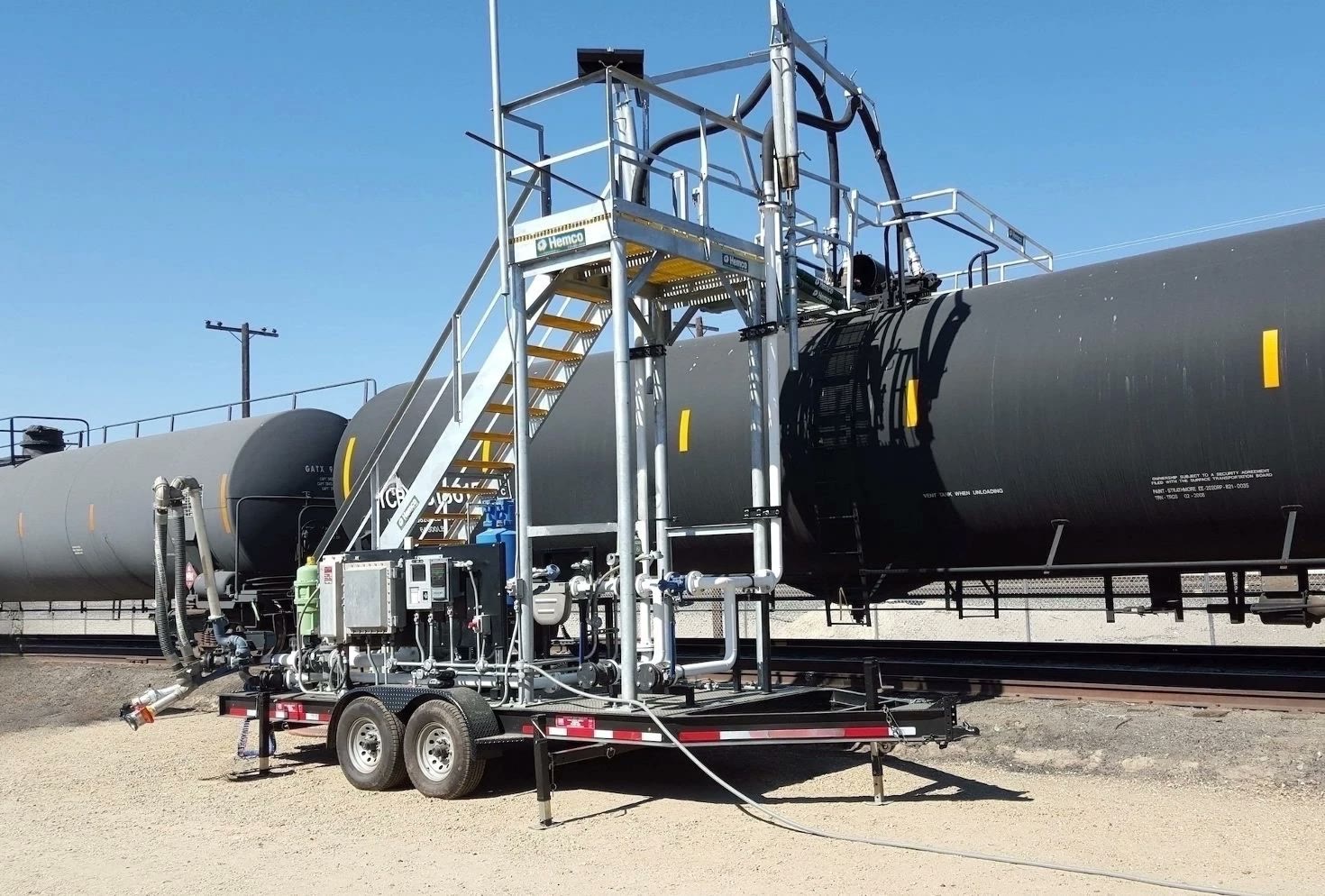
One unit rolls to where the work is. The twice-a-month spot, the seasonal product, the rack you haven't committed to yet. Quoted in days, on site in weeks, no civil work. It's also the honest first step: it tells us both whether a fixed spot ever earns itself.
For the spots that load every shift: a fixed platform with a self-leveling gangway and hatch cage. Stainless or galvanized matched to your service, tracking carriage when one platform covers two spots. Engineered drawing and code references included.
Pre-engineered, no-weld, bolt-together. Process access, tank-farm steps, and containment-berm crossings installed without a hot-work permit inside your dike.
And the transfer side runs through our sister company Consolidated. Hoses, fittings, swivels, gaskets, and loading-arm components for the same racks, on the recurring side of the same relationship. One call covers the access and the connection.
Mid-market chemical plants don't get cited for what's in the SOP. They get cited for the two-minute climbs nobody ever wrote down. So that's the offer: we walk your rack, your spots, and your dike, and tell you what we'd flag. Including the part nobody else puts in writing: what you don't need to buy.
Three ways in: the free Site Visit (one problem, solved and quoted) · the Operational Assessment (a whole operation against every level of compliance, logged. Fee credited back on your first solution) · the Gangway Inspection Program (we service the gangways you already own. Any major brand. Springs, parts, and a spec list of what to watch).
Inland Empire and SoCal blenders. The Front Range and the I-25 corridor. Salt Lake's industrial row. The Vegas corridor. The Northwest. Site visits measured in hours of driving, not a flight from the other coast.
We come stand in front of it. Measurements, the spatial envelope, a worked solution, and a quote. Free, every time. That's how we earn the next conversation.
Book the visit →Have the spec or the drawing? Skip the walk. Send it over and we'll turn the quote fast, engineered drawing and references attached.
Start an RFQ →